
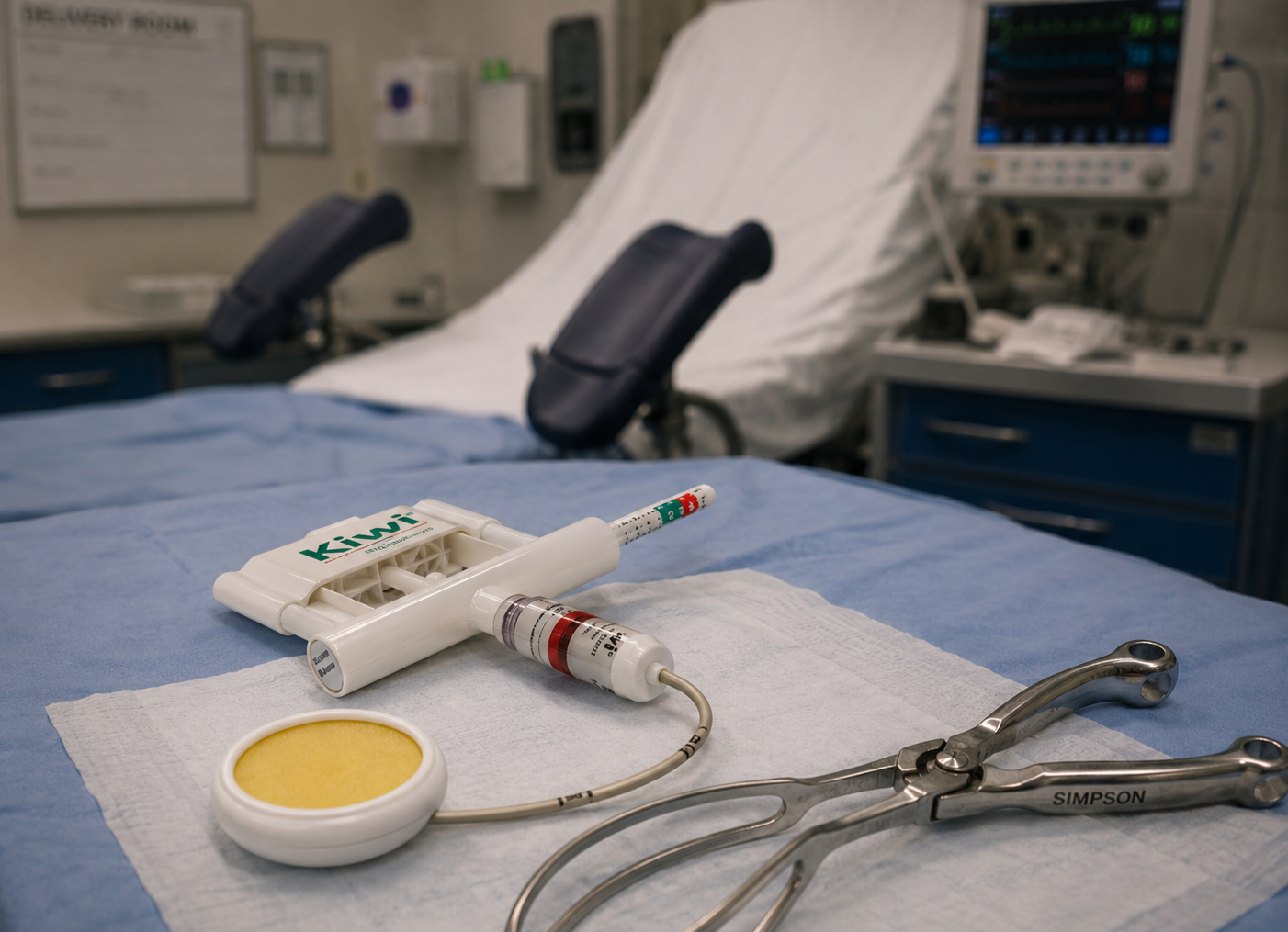
For attorneys, legal nurse consultants, litigation teams, claims professionals, and healthcare risk professionals evaluating OB-GYN matters.
Before an operative vaginal delivery, I want to see that the basics were confirmed: cervix fully dilated, membranes ruptured, the fetal head engaged, and station and position clearly known. Beyond that, a good clinician is thinking about pelvic adequacy, estimated fetal size, anesthesia, whether the bladder was emptied, fetal status, the mother's condition, who's actually available in the room, and whether an emergency cesarean could be performed quickly if the attempt doesn't work out. The indication for the procedure and the conversation with the patient should be documented as fully as the situation allowed.
The procedure note itself needs to let me reconstruct what actually happened: which device or forceps were used, how they were applied, how many pulls or traction efforts were made, whether the vacuum cup detached at any point, whether the head descended with traction, how long the attempt lasted, why it was stopped, and how mother and baby were doing afterward. I want to be clear about something, though — a failed attempt isn't automatically a sign of negligence. What matters more is whether the clinician kept going without any descent, or pushed past a reasonable point to stop.
Any injury that results has to be looked at on its own terms. Scalp trauma, cephalohematoma, subgaleal hemorrhage, facial injury, skull fracture, intracranial hemorrhage, a maternal laceration, pelvic-floor injury — these all come from different mechanisms and carry different background risk, even with appropriate technique. The fact that a recognized complication happened doesn't by itself mean the technique was wrong, but the specific type and pattern of injury can still tell us something important about causation.
I also think it's worth stepping back and asking what the real alternative looked like at that exact moment. Did fetal status actually call for immediate delivery? How far had the head descended already? What risks would a second-stage cesarean have carried for the mother right then? A balanced opinion weighs the path that was chosen against the realistic options available in that moment — not against some idealized alternative that only looks clean in hindsight.
Questions for Counsel
- What does the contemporaneous record document regarding fetal position, station, clinical indication, maternal counseling, and the other factors considered before operative vaginal delivery?
- How was the operative vaginal delivery characterized in the record, and what does the documentation show regarding fetal station, position, instrument selection, and operator experience?
- Was sequential instrument use (vacuum followed by forceps or vice versa) employed, and if so, is that documented — and was it clinically justified?
- How many traction attempts were made, and what was the clinical decision point for abandoning operative vaginal delivery in favor of cesarean?
- Does the neonatal examination document the type, location, and extent of any injury — and is that injury pattern consistent with the documented instrument application?

Disclaimer: This material is for general educational purposes and does not constitute legal advice, medical advice, or a case-specific standard-of-care or causation opinion. Clinical guidance changes over time. Every matter requires review of the complete record, applicable guidance in effect on the date of care, local resources, and jurisdiction-specific legal standards. For consultation on a specific case, contact OBGYN Peer.