
For attorneys, legal nurse consultants, litigation teams, claims professionals, and healthcare risk professionals evaluating OB-GYN matters.
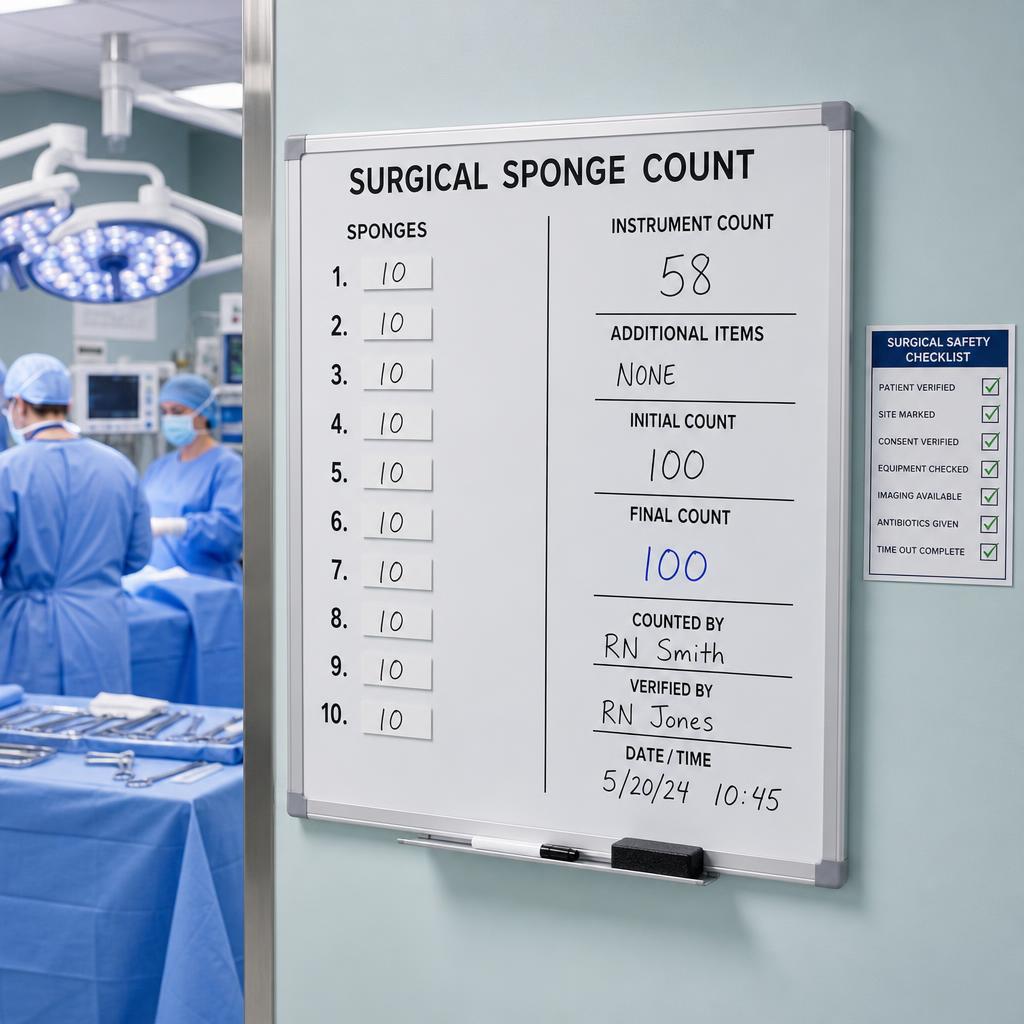
Prevention of retained surgical items generally depends on a coordinated team process involving standardized counts, communication, appropriate wound exploration, resolution of count discrepancies, and imaging when indicated. I'll acknowledge that emergency conditions, an unplanned change mid-procedure, heavy blood loss, multiple teams cycling through, staff turnover, obesity, and complex surgery all raise the risk — but none of that erases the need for these safeguards to actually work.
A thorough review pulls in the count sheets, nursing records, both the operative and anesthesia notes, preference cards, any device logs, radiology, incident review if it's discoverable, and whatever facility policy was actually in effect at the time. I want to know whether counts were documented as correct, incorrect, waived, or left unresolved — and what happened next in each case. It's also worth remembering that not every retained item shows up clearly on imaging; some fragments simply aren't radiopaque.
Responsibility here often extends well past the surgeon. It can involve how the nursing count was performed, how the surgeon responded once a discrepancy came up, the institution's own policy, what technology was even available, how the team communicated, and how well any of it was documented. Where legal fault ultimately lands is a question of jurisdiction, not medicine — but as a medical expert, I can speak clearly to each person's clinical role and whether the safety process itself fell short of expected practice.
And causation still has to be established — it doesn't follow automatically. A retained item can cause infection, pain, obstruction, a fistula, erosion, the need for repeat surgery, or, for a stretch of time, nothing noticeable at all. So I connect the specific object and its location to the actual symptoms being claimed, and I separate that harm carefully from whatever was already caused by the underlying disease or the original operation itself.
Questions for Counsel
- What does the operative record document regarding surgical counts, any discrepancies, and the steps taken to reconcile the count before completion of the procedure?
- If a count discrepancy was documented, what is the record of the response — was a cavity search performed, was intraoperative imaging obtained, and was the discrepancy reconciled or resolved before closure?
- What technology was available and in use at the time of the procedure — standard radiograph-tagged sponges, RFID sponge detection, or no adjunct technology — and was the available technology used?
- When did the patient first report postoperative symptoms consistent with RSI, and at what point was the retained item discovered — and is there a record of the clinical evaluation that occurred at each presentation?
- What are the patient's damages attributable to the retained item — secondary surgery, infection, organ injury from migration, prolonged pain — and can each be temporally linked to the retained item?

Disclaimer: This material is for general educational purposes and does not constitute legal advice, medical advice, or a case-specific standard-of-care or causation opinion. Clinical guidance changes over time. Every matter requires review of the complete record, applicable guidance in effect on the date of care, local resources, and jurisdiction-specific legal standards. For consultation on a specific case, contact OBGYN Peer.